
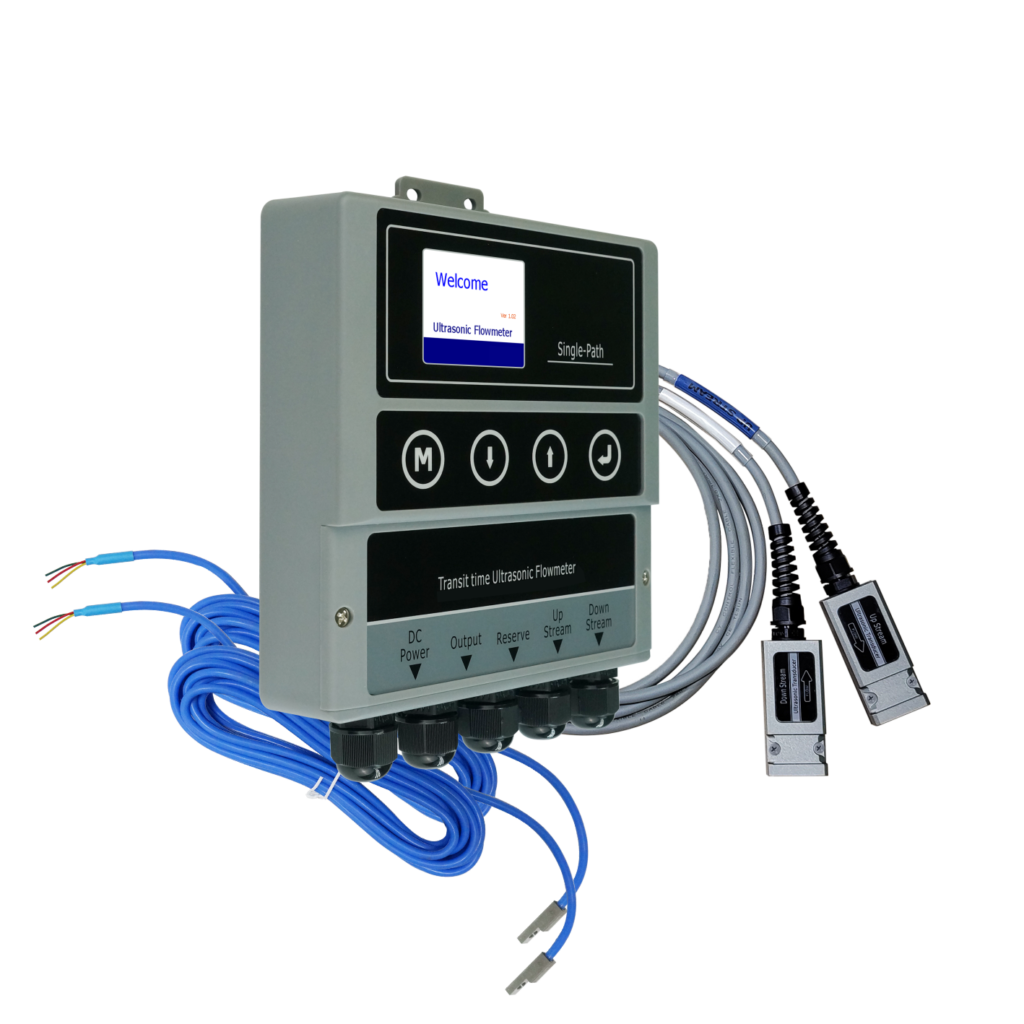
Facilities do not buy water for its own sake — they buy (or sell) thermal energy: chilled water from a plant, heat from a district network, cooling for a data hall. A BTU energy meter (also called heat meter, cooling meter or thermal energy meter) measures exactly that: energy delivered, in kWh, MWh or BTU.
The Physics: Flow × Temperature Difference
Thermal power is beautifully simple:
Q = ṁ × c × ΔT
Energy equals mass flow multiplied by the liquid’s specific heat, multiplied by the temperature drop between the supply pipe and the return pipe. A BTU meter therefore has two jobs:
- Measure volumetric flow — in modern clamp-on designs, with the ultrasonic transit-time method;
- Measure supply and return temperature — with a paired set of precision sensors.
The instrument integrates power over time and totals the energy. The critical detail is the temperature pairing accuracy: because ΔT is often just a few degrees, a 0.1 °C error is significant. Quality energy meters use matched sensor pairs with pairing error below ±0.2 °C — ours achieves exactly that on the YF-E6, with overall energy accuracy of ±2.0%.
Where BTU Meters Are Used
- District heating and cooling — billing energy delivered to each building instead of estimating from running hours.
- Tenant and department sub-metering — fair allocation of HVAC costs in commercial buildings and campuses.
- Chiller and boiler efficiency — comparing energy produced against electricity/fuel consumed reveals COP degradation early.
- Data centres and industry — tracking cooling energy per hall or process line for ESG reporting and optimisation.
Why Choose a Clamp-On Energy Meter?
Traditional energy meters are inline devices: installing them means cutting the pipe and shutting down. A clamp-on energy meter pairs a strap-on ultrasonic flow sensor with strap-on temperature sensors — the YF-E6 retrofits onto DN25–DN2000 pipework with no shutdown and no pressure loss, making energy projects feasible in occupied buildings and continuous plants. Outputs (4–20 mA, RS485 Modbus RTU, OCT, relay) feed BMS/SCADA and billing systems directly.
Pair flow measurement with our product brochures to shortlist models before you tender.
Frequently Asked Questions
What is the difference between a flow meter and an energy meter?
A flow meter reports volume (m³). An energy meter additionally measures supply/return temperatures and reports thermal energy (kWh/BTU), which is what heating and cooling are actually bought and sold in.
Can one BTU meter serve both heating and cooling?
Yes. The calculation is symmetric — it simply tracks whether energy is delivered or extracted, so the same instrument meters chilled water in summer and hot water in winter.
How accurate is clamp-on energy metering?
The YF-E6 achieves ±2.0% energy accuracy with ±0.2 °C sensor pairing over DN25–DN2000 — suitable for cost allocation and efficiency monitoring. For revenue-grade custody transfer, consult us on installation conditions.
Related Reading
- Clamp-On Meters in HVAC & District Energy
- Measuring Hot, Chilled Water & Other Liquids
- Flow Meter Outputs: 4-20mA, Pulse, Modbus, GPRS
- What Is a Clamp-On Ultrasonic Flow Meter?
- Choosing a Flow Meter by Application
Need Help Selecting a Flow Meter?
YS-Flux manufactures clamp-on ultrasonic flow meters for wholesale, export and OEM/private-label partners. Tell us your pipe size, liquid and application — our engineers will recommend the right model and quote within one business day. Request a Quote →
Browse our complete range on the Products page.
Questions about your application? Contact our team or request a quote — we respond within 24 hours.