
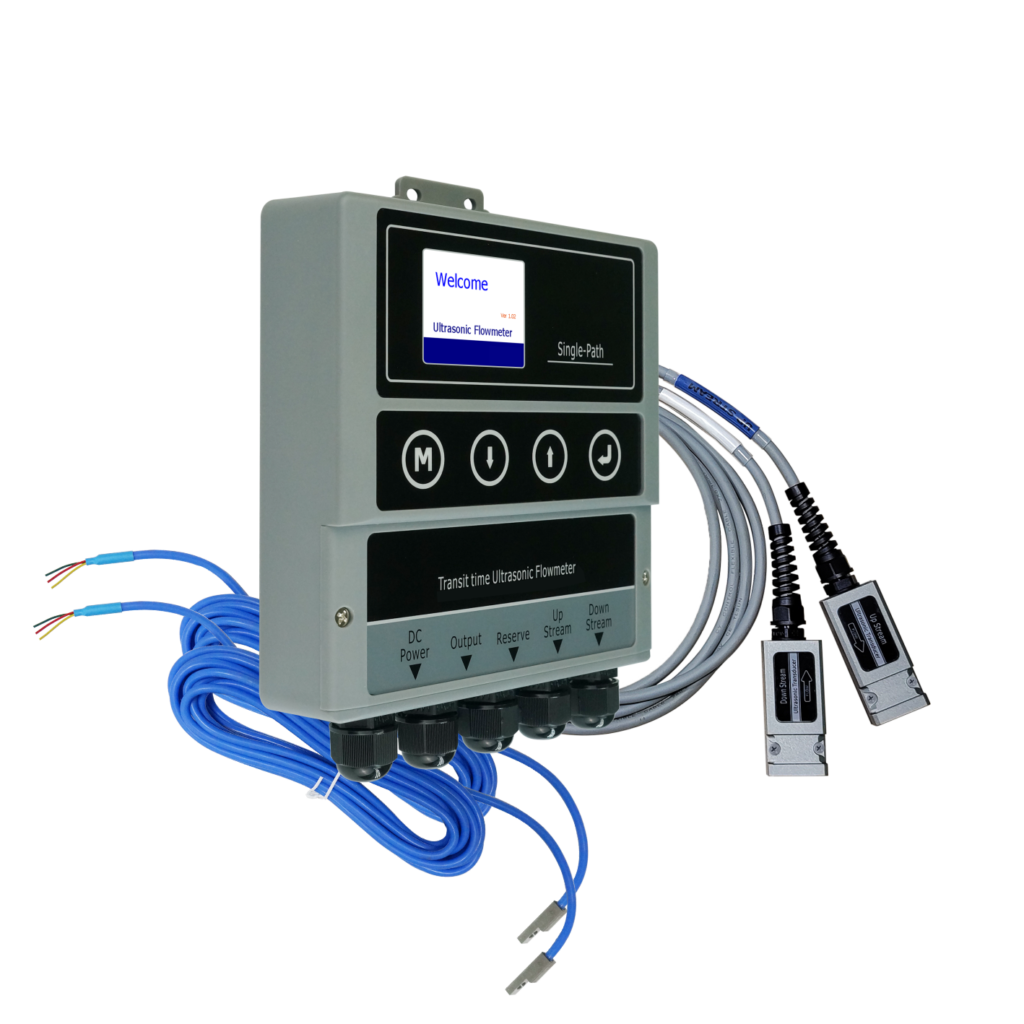
The short answer is yes — very much so. Hot water and chilled water are in fact two of the most common applications for clamp-on ultrasonic meters, sitting at the heart of HVAC, district heating/cooling and building-services work. Because the transducers measure through the pipe wall and never touch the fluid, the same meter can be used across an unusually wide range of liquids — provided the liquid conducts ultrasound and is relatively clean. New to the principle? See our clamp-on flow meter overview and how the transit-time method works.
Water in All Its Forms
- Chilled water (typically 5–12 °C) — air-conditioning and process cooling loops. Excellent transit-time application; standard transducers and couplant.
- Cooling / condenser water — cooling-tower loops, data-centre and process cooling.
- Hot water — heating systems and domestic hot water up to around 80 °C use standard transducers; hotter lines need high-temperature transducers (see below).
- Boiler feed, demineralised / deionised water, condensate — all measure well; note demineralised water is fine for ultrasonic (unlike magnetic meters, which rely on conductivity).
- Raw water, potable water, seawater / brine — all measurable; seawater and mild solutions conduct sound well.
Hot Water and High Temperatures
Standard clamp-on transducers and coupling compound are generally rated to roughly 80 °C (some to 120 °C depending on model). For hotter lines — high-temperature hot water, thermal fluids and process lines — high-temperature transducers and high-temperature couplant extend the range to around 150 °C or more on premium units such as the YF-C8. At the top end, mounting rails and straps are specified for the temperature, and a small stand-off/heat-sink arrangement may be used. Pipe surface temperature at the transducer location is what matters, so lagging can be removed just at the two patches.
Other Clean Liquids
Transit-time ultrasonic meters work on essentially any clean, single-phase, sound-conducting liquid, including:
- Oils — hydraulic oil, lubricating oil, thermal oil (note oils have a different sound speed; select the correct fluid type so the meter uses the right sound-speed/temperature relationship).
- Chemicals and solvents — acids, alkalis, alcohols, glycol/water mixes and many process fluids. Because measurement is non-contact, chemical compatibility of wetted parts is a non-issue — there are no wetted parts.
- Glycol solutions — common in chilled/heating loops; select the fluid type (glycol % affects sound speed).
- Beverages and food-grade liquids — where clean, homogeneous liquids are handled.
If the goal is heating/cooling energy rather than just flow, a clamp-on energy meter pairs flow with supply/return temperature sensors to totalise kWh/BTU on exactly these hot- and chilled-water loops — see how BTU/energy metering works and the YF-E6 energy meter.
What Transit-Time Struggles With
The limit is not the liquid’s chemistry but its physical state. Transit-time needs ultrasound to cross the fluid cleanly, so it struggles with liquids that scatter the signal:
- Heavy suspended solids — sludge, slurry, pulp, high-turbidity wastewater.
- Entrained gas / aeration above roughly a few-to-ten percent.
- Viscous, non-full, or two-phase/laminar problem cases beyond the meter’s low-flow threshold.
For those fluids a Doppler ultrasonic meter (which relies on reflections from the particles/bubbles) or an inline magnetic meter is the correct choice — see transit-time vs Doppler. When in doubt, a portable survey confirms it on site in minutes.
Quick Liquid Compatibility Reference
| Liquid | Transit-time clamp-on | Notes |
|---|---|---|
| Chilled water (5–12 °C) | Excellent | HVAC/cooling loops; standard transducers |
| Cooling/condenser water | Excellent | Cooling towers, data centres |
| Hot water (to ~80 °C) | Excellent | Standard transducers/couplant |
| High-temp hot water / thermal fluid (>80 °C) | Good | High-temp transducers/couplant (to ~150 °C+) |
| Demineralised / DI water | Excellent | Works where mag meters cannot (no conductivity needed) |
| Seawater / brine | Good | Select correct fluid sound speed |
| Oils (hydraulic/thermal/lube) | Good | Select oil fluid type; sound speed differs |
| Chemicals / solvents / glycol | Good | Non-contact = no wetted-parts compatibility issue |
| Slurry / sludge / pulp | Poor | Use Doppler or magnetic meter |
| Heavily aerated liquid | Poor | Use Doppler; remove gas if possible |
Choosing and Setting Up for the Liquid
- Select the correct fluid type in the meter (water, seawater, oil, glycol mix, etc.) so it applies the right sound-velocity profile — this directly affects accuracy, as covered in our accuracy factors guide.
- Match transducers to temperature: standard for chilled/nominal hot water, high-temperature for >80 °C lines.
- For energy on hot/chilled loops, use the YF-E6 with paired temperature sensors; for flow-only monitoring the YF-C6 (fixed) or YF-C8 (large/high-accuracy) and portable YF-P1/YF-P2 for surveys.
- Application-to-model mapping is in our application selection guide; fluid and temperature tables are in the manuals on the Downloads page.
Frequently Asked Questions
Can a clamp-on ultrasonic meter measure hot water?
Yes. Hot water up to about 80 °C works with standard transducers and coupling compound; for hotter lines (high-temperature hot water, thermal fluids) use high-temperature transducers and high-temperature couplant, which extend the range to around 150 °C or more on premium units like the YF-C8.
Can it measure chilled water for HVAC?
Yes — chilled water (typically 5–12 °C) is one of the most common clamp-on applications, across air-conditioning, cooling-tower and district-cooling loops. Standard transducers work well. If you need cooling/heating energy in kWh/BTU rather than just flow, use an energy meter like the YF-E6 with paired supply/return temperature sensors.
What liquids cannot be measured with transit-time ultrasonic?
Transit-time needs a clean, single-phase liquid. It struggles with heavy suspended solids (sludge, slurry, pulp) and heavily aerated/gas-bearing fluids, because the particles and bubbles scatter the ultrasound. For those, use a Doppler ultrasonic meter (which uses the reflections) or an inline magnetic meter. Clean water — including demineralised water — oils, seawater, glycol and most chemicals all measure well.
Tell Us Your Liquid and Temperature
YS-Flux transit-time clamp-on meters cover chilled water, hot water and a broad range of clean liquids across standard and high-temperature configurations. Send us your liquid, operating temperature, pipe size and material — our engineers will confirm the model, transducer set and energy/flow option within one business day. Request a Quote →
Browse our complete range on the Products page.