Clamp-on ultrasonic flow meters all look similar from the outside — two transducers strapped to a pipe — but inside they use one of two very different measurement principles: transit-time and Doppler. They are not interchangeable. Pick the wrong one for the liquid and you get no reading at all, or a badly wrong one. The good news is the choice is mostly decided by what is in the liquid. Here is how each works, where they differ, and how to choose.
Transit-Time: Timing Sound With and Against the Flow
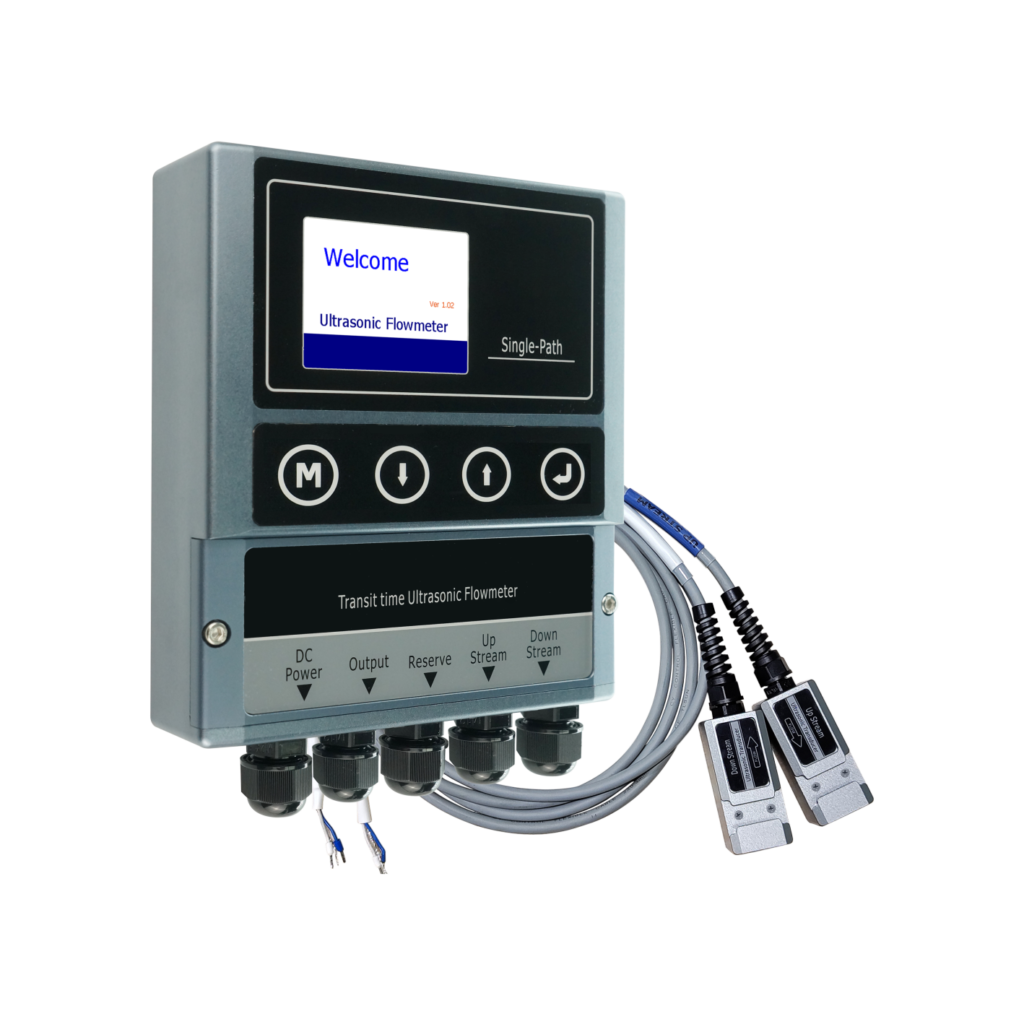
A transit-time meter sends an ultrasonic pulse between two transducers, first with the flow (downstream) and then against it (upstream). Sound travelling with the current arrives a fraction sooner; sound fighting the current arrives a fraction later. The meter measures that tiny time difference (Δt) with nanosecond precision and converts it to flow velocity, then to volumetric flow. It repeats hundreds of times per second.
- Needs: a clean, single-phase liquid that lets the pulse cross the pipe cleanly — water, demineralised water, seawater, chilled/hot water, chemicals, solvents, oils.
- Tolerates: a small amount of suspended solids or gas bubbles (a few percent) with modern signal processing.
- Delivers: high accuracy — typically ±0.5% to ±1.0% of reading on quality instruments — and excellent repeatability across a wide velocity range.
This is the technology used across the entire YS-Flux range; the physics are explained in our how clamp-on ultrasonic meters work article and the numbers in our accuracy guide.
Doppler: Bouncing Sound Off Particles
A Doppler meter also transmits ultrasound, but it does not rely on a pulse crossing the liquid. Instead it aims the signal into the flow and listens for reflections from moving particles or gas bubbles suspended in the liquid. Like the pitch of a passing siren, the frequency of the reflected sound shifts in proportion to how fast those particles are moving — the Doppler effect. That frequency shift gives the flow velocity.
- Needs: the liquid to contain reflectors — suspended solids, entrained gas bubbles, sludge or aeration. In perfectly clean water there is nothing to reflect the signal, so a Doppler meter cannot read it.
- Typical liquids: wastewater and sewage, slurries, sludge, pulp, aerated or dirty process fluids, drainage with solids.
- Delivers: reliable flow indication on liquids transit-time cannot penetrate, but at lower and more variable accuracy (commonly ±2% to ±5% of full scale/reading, depending on particle loading) because it infers bulk velocity from particles rather than timing the fluid directly.
Side-by-Side Comparison
| Factor | Transit-time | Doppler |
|---|---|---|
| Measurement basis | Pulse travel-time difference (Δt) | Frequency shift off particles/bubbles |
| Liquid required | Clean, single-phase (few % solids OK) | Must contain solids or entrained gas |
| Clean water | Works well | Cannot read (no reflectors) |
| Slurry / wastewater / aerated | Poor / signal scatters | Works |
| Typical accuracy | ±0.5–1.0% of reading | ±2–5% (depends on loading) |
| Low-flow / low-velocity | Good (down to ~0.01 m/s) | Weaker; needs adequate reflectors |
| Energy (BTU) metering | Yes (paired temp sensors) | Rarely / not typical |
| Clamp-on / no shutdown | Yes | Yes (same external mounting) |
Both are clamp-on/non-intrusive — the mounting, no-shutdown advantage and installation rules are the same (see the V-method/Z-method installation guide). The difference is purely in the signal physics and therefore the liquid they can measure.
How to Choose
- Water, clean process liquids, chemicals, oils, HVAC thermal fluids, anything relatively clear → transit-time. This covers the majority of industrial, municipal water, building-services and energy applications — and the entire YS-Flux line-up: fixed YF-C6, premium YF-C8, energy meter YF-E6, and portable YF-P1/YF-P2.
- Wastewater with solids, sludge, slurry, pulp, heavily aerated or gas-bearing fluids → Doppler-type instrument (or, in some cases, inline magnetic metering). Transit-time will struggle once solids or gas exceed roughly 10% or the liquid no longer passes sound cleanly.
- Borderline fluids (slightly dirty water, occasional bubbles) → modern transit-time meters with advanced signal processing often still read; check with the supplier and, if possible, verify on site with a portable unit before committing to a fixed install.
Our application-by-application guide (choosing by application) and the general clamp-on flow meter overview map these choices to specific models and industries.
A Practical Tip
If you are unsure about the liquid, a portable transit-time meter (YF-P1/YF-P2) is the fastest way to find out: clip it on and check the on-screen signal quality. A strong, stable signal means transit-time will work on that fluid; no signal despite good mounting and a full pipe suggests the liquid is too aerated or solids-laden — and points toward Doppler or magnetic technology. Datasheets and signal thresholds are on the Downloads page.
Frequently Asked Questions
What is the main difference between transit-time and Doppler ultrasonic flow meters?
Transit-time meters measure the difference in travel time of ultrasonic pulses sent with and against the flow, and require a relatively clean liquid; they give high accuracy (±0.5–1.0%). Doppler meters measure the frequency shift of ultrasound reflected off suspended particles or gas bubbles, so they need dirty/aerated liquid to work at all, and are less accurate (roughly ±2–5%).
Can a Doppler meter measure clean water?
No. Doppler relies on reflectors — particles or entrained gas — in the liquid. Perfectly clean water has nothing to reflect the signal, so a Doppler meter gives no reading. Clean water is exactly the case for a transit-time meter.
Which type does YS-Flux supply?
The YS-Flux clamp-on range (compact, fixed YF-C6, premium YF-C8, energy YF-E6 and portable YF-P1/YF-P2) uses the transit-time principle, designed for water and clean single-phase liquids. For heavily solids-laden or aerated fluids we will advise whether a Doppler-type instrument or inline magnetic meter is more appropriate for your application.
Not Sure Which Method Fits Your Liquid?
YS-Flux specialises in transit-time clamp-on ultrasonic meters — compact, fixed, premium, energy and portable models for water and clean-liquid applications. Send us your liquid type, solids/gas content, pipe size and temperature, and our engineers will confirm the right technology and model (or advise if a Doppler-type instrument suits your fluid) within one business day. Request a Quote →
Browse our complete range on the Products page.
Questions about your application? Contact our team or request a quote — we respond within 24 hours.