
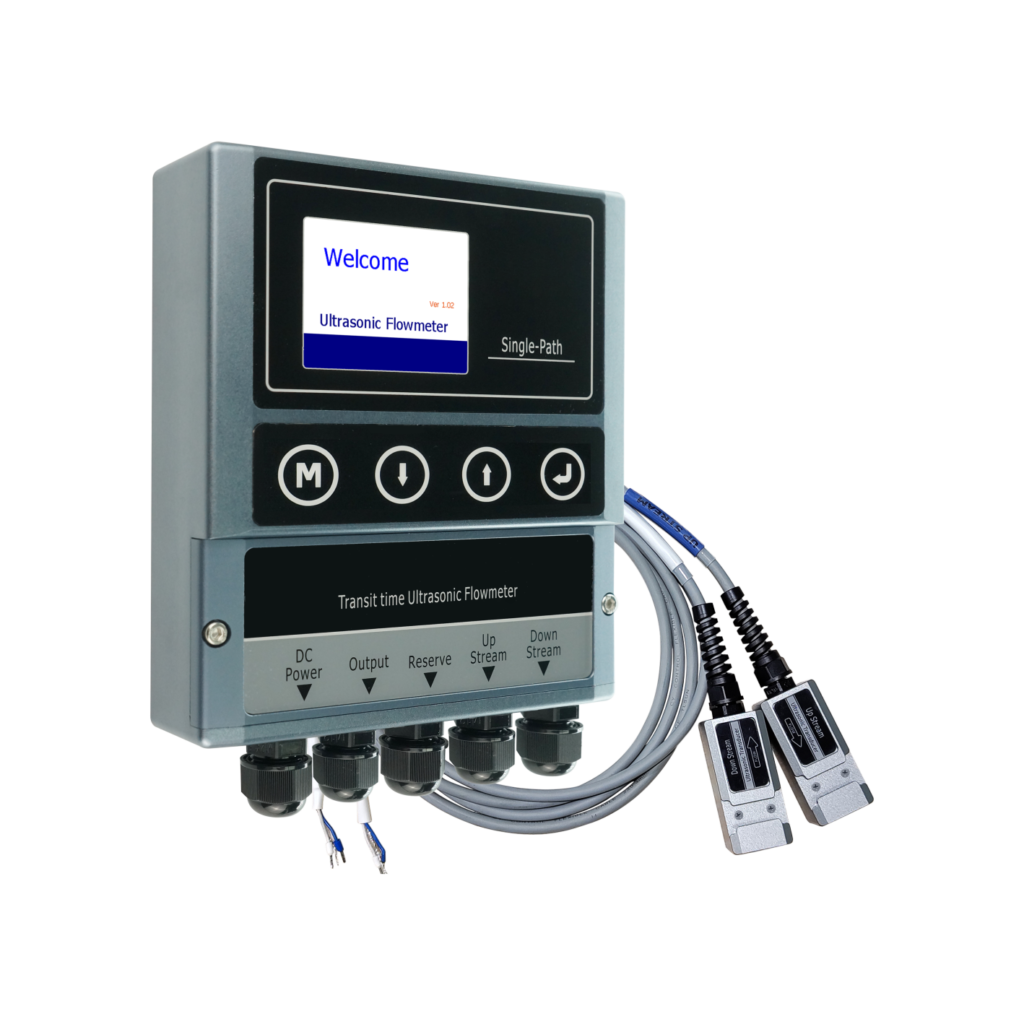
A clamp-on ultrasonic flow meter is a non-intrusive instrument that measures the flow rate of liquid in a pipe from the outside. Instead of being inserted into the pipeline like a traditional meter, it uses a pair of ultrasonic transducers that strap or clamp onto the pipe wall — no pipe cutting, no process shutdown, no contact with the liquid, and no pressure loss. It is the fastest-growing flow measurement technology for water and clean-liquid applications, and this article explains what it is, what it consists of, which types exist, and how to pick one. For the physics behind the measurement, see our deep-dive on how a clamp-on ultrasonic flow meter works.
The Definition in One Paragraph
A clamp-on (also called strap-on or non-intrusive) ultrasonic flow meter sends ultrasonic pulses through the pipe wall and the liquid inside. By timing how those pulses travel with and against the flow, the instrument calculates the fluid’s velocity, then converts it to volumetric flow rate (m³/h, L/min, GPM) using the pipe’s internal diameter. The transducers never touch the process fluid, so the meter can be fitted to a live, pressurised line in minutes and removed again without a trace.
What Does a Clamp-On System Consist Of?
- A pair of ultrasonic transducers — rugged sensors (IP68-rated on good models) that transmit and receive the ultrasonic signal, mounted on the pipe with straps, chains or a bolted bracket.
- A transmitter / converter — the electronics unit that drives the transducers, processes the signal, and displays flow rate, totalised volume and diagnostics. Wall-mounted on fixed systems, or built into a handheld body on portables.
- Coupling compound (couplant) — a thin layer of acoustic gel between each transducer and the pipe that fills microscopic gaps so sound can enter the pipe wall efficiently.
- Mounting hardware — stainless straps or clamping frames that hold the transducers at a precise, calculated spacing.
- Outputs and options — local display, 4–20 mA, pulse/OCT, RS485 Modbus RTU, data logging, and (on premium models) GPRS/4G cloud reporting. Energy versions add paired temperature sensors.
Two Measurement Types: Transit-Time vs Doppler
Almost all clamp-on ultrasonic meters fall into one of two categories:
- Transit-time (time-of-flight) — measures the difference in travel time of pulses sent upstream and downstream. Works on clean, single-phase liquids (water, demineralised water, seawater, hot/chilled water, chemicals, oils) and delivers the highest accuracy — typically ±0.5% to ±1.0% of reading on quality instruments. This is the technology used across the YS-Flux range.
- Doppler — bounces ultrasound off suspended particles or gas bubbles in the liquid and measures the frequency shift. Used for dirty or aerated liquids (slurries, wastewater with solids) where transit-time cannot penetrate. Accuracy is lower and the pipe must contain enough reflectors.
If you are weighing this against traditional metering, our clamp-on vs inline flow meter comparison breaks down installation cost, pressure loss and maintenance side by side.
Why Teams Choose Clamp-On
- No shutdown, no pipe modification — install on live lines in 30 minutes to a couple of hours; critical for occupied plants, retrofit projects and infrastructure that cannot stop.
- Zero pressure loss, zero leak risk — nothing penetrates the pipe, so there is nothing to obstruct flow or create a leak point.
- One meter, a huge pipe range — a single instrument covers everything from small lines (OD 9 mm on compact models) up to DN5000 (200″) transmission mains.
- Any pipe material — carbon steel, stainless, cast iron, PVC, HDPE, copper, even lined pipes.
- Chemical and corrosion immunity — sensors never meet aggressive, ultra-pure or sanitary liquids.
- Portability — battery handhelds let one technician survey dozens of measurement points, balance HVAC loops, test pumps or verify installed meters in a day.
- Low total cost — no flanges, welding, gaskets, downtime or civil works; the installed cost is often a fraction of an inline meter, especially on large diameters.
Limitations to Know About
- Transit-time needs clean liquid and a full pipe — heavily aerated or slurry-like fluids call for Doppler or other technologies; partially filled pipes read incorrectly.
- Installation quality drives accuracy — the right straight run (typically ≥10D upstream), a clean prepared surface and correct transducer spacing matter. Our clamp-on installation guide (V-method, Z-method) covers the rules that prevent 90% of field problems.
- Very thick or heavily scaled walls can weaken the signal — usually solved with Z-method mounting or high-power transducers.
The YS-Flux Clamp-On Range at a Glance
- YF-E5 / YF-C3 / YF-C3M — compact clamp-on meters for small pipes and tight spaces (from OD 9 mm); integrated low-profile design.
- YF-C6 — fixed clamp-on workhorse for permanent plant monitoring, DN25–DN2000, ±1.0% accuracy, full output options.
- YF-C8 — premium fixed model: ±0.5% accuracy, pipes up to DN5000, high-temperature transducers (150 °C), GPRS remote monitoring.
- YF-E6 — clamp-on energy (BTU/heat) meter with paired temperature sensors for heating and cooling energy; details in our BTU energy meter explainer.
- YF-P1 / YF-P2 — portable handheld survey meters with long battery life; the YF-P2 adds a 3.5″ rotating IPS display and coverage up to DN5000.
Where They Are Used
Water supply networks and water treatment, HVAC chilled/hot water balancing, district heating and cooling, pump and valve testing, energy audits, chemical and process industries, irrigation, building management systems, and temporary flow surveys. Energy variants underpin tenant sub-metering and chiller/boiler efficiency monitoring.
How to Choose the Right One
The decision comes down to pipe size and material, liquid cleanliness, temperature, required accuracy, outputs, and fixed-versus-portable use — our 7-factor ultrasonic flow meter selection guide walks through each, and full specification sheets are on the Downloads page. OEM and private-label buyers can see our OEM services.
Frequently Asked Questions
What is a clamp-on ultrasonic flow meter in simple terms?
It is a flow meter that clips onto the outside of a pipe and uses ultrasound to measure how fast liquid is moving inside — without cutting the pipe, stopping the process, or touching the liquid.
Can a clamp-on meter be used on any pipe?
It works on virtually all common pipe materials — steel, stainless, cast iron, PVC, HDPE, copper and lined pipes. The liquid should be clean for transit-time models, and the pipe must run full; small lines from OD 9 mm up to DN5000 are covered depending on the model.
How accurate is a clamp-on ultrasonic flow meter?
Quality transit-time instruments achieve ±1.0% of reading (e.g. YF-C6), with premium models such as the YF-C8 reaching ±0.5% — comparable to many inline meters when installed with adequate straight run and proper surface preparation.
Need Help Selecting a Clamp-On Flow Meter?
YS-Flux manufactures clamp-on ultrasonic flow meters — compact, fixed, energy and portable — for wholesale, export and OEM/private-label partners. Tell us your pipe size, liquid and application; our engineers will recommend the right model and quote within one business day. Request a Quote →
Browse our complete range on the Products page.