The short answer: a good clamp-on ultrasonic flow meter measures at ±0.5% to ±1.0% of reading for clean liquids installed under the right conditions — comparable to many inline meters. The longer answer is that a published accuracy figure is a laboratory number, and real-world performance depends heavily on installation, pipe and liquid conditions. This article explains what the numbers mean, what moves them, and how to make sure a meter actually achieves its rated accuracy on your pipe.
The Headline Numbers
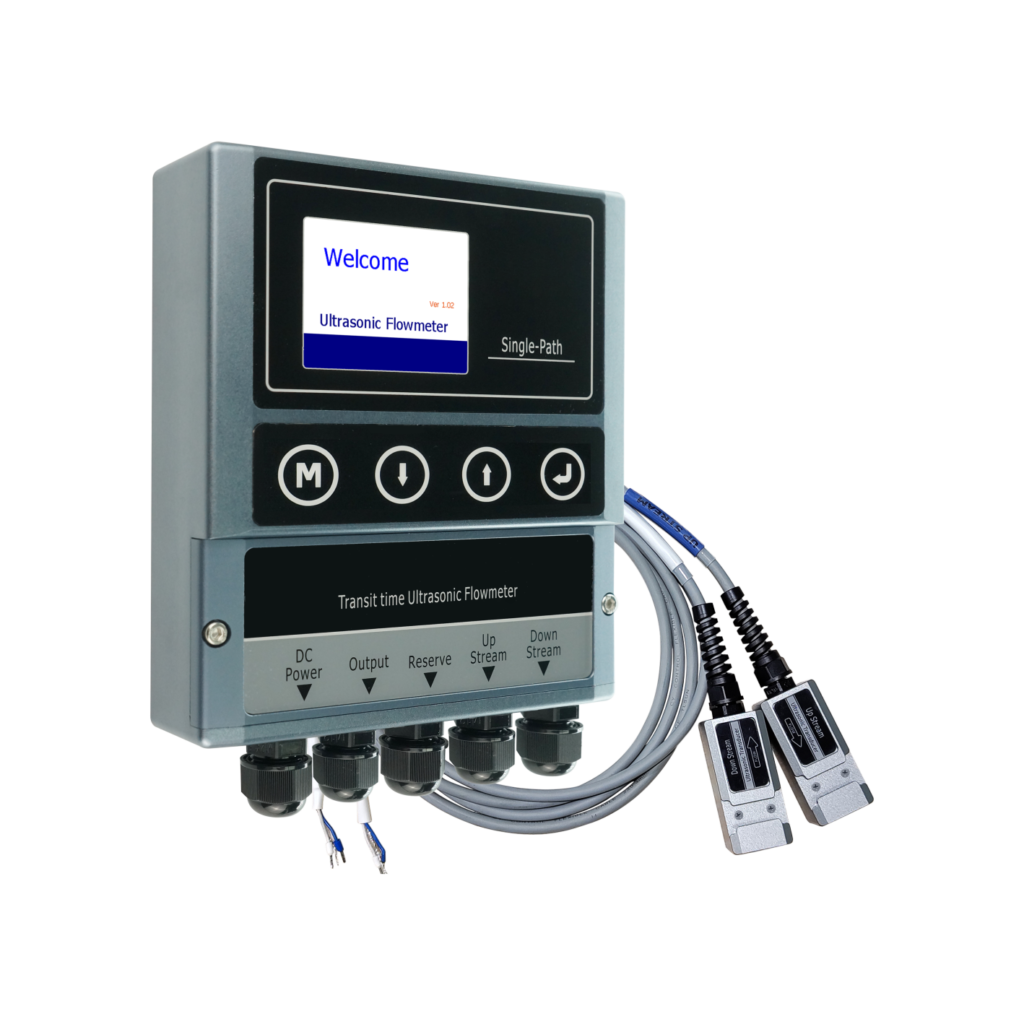
- Standard industrial clamp-on (transit-time): typically ±1.0% of reading (e.g. the YF-C6 fixed clamp-on). This is ample for process monitoring, water balance, pump testing and HVAC.
- Premium / high-performance units: ±0.5% of reading with advanced signal processing and matched transducers (e.g. the YF-C8), suited to custody-adjacent duties, precise plant balancing and large transmission mains.
- Portable survey meters: around ±1.0% of reading (YF-P1, YF-P2) — designed for spot checks and verification, not custody transfer.
- Energy (BTU) metering: overall energy accuracy around ±2.0% on the YF-E6, dominated by the paired temperature sensors (±0.2 °C pairing error), not just the flow channel.
Note these are usually quoted as % of reading (rate), not % of full scale — an important distinction at low flow. If you are new to the technology, start with our what is a clamp-on ultrasonic flow meter overview.
Accuracy vs Repeatability vs Resolution
Buyers sometimes chase accuracy when what they actually need is repeatability:
- Accuracy — how close the reading is to the true flow value.
- Repeatability — how consistently the meter reads the same flow under the same conditions. Clamp-on meters are highly repeatable (often ±0.2–0.5%), which makes them excellent for relative tasks: balancing loops, detecting changes, comparing branches — even if an absolute calibration offset exists.
- Resolution / rangeability — ultrasonic meters measure across a very wide velocity range (typically 0.01–12 m/s or more) without losing the low end, unlike mechanical meters that stall at low flow.
What Determines Real-World Accuracy?
The instrument is only half the system — the installation is the other half. These are the factors that move accuracy in the field:
- Straight pipe run. Elbows, tees, valves and pumps distort the velocity profile. Aim for ≥10D straight pipe upstream (≥30D after valves, ≥50D after pumps) and ≥5D downstream. Short runs bias the average-velocity reading. Full mounting rules are in our installation guide (V-method / Z-method).
- Pipe data entered correctly. The meter calculates flow from velocity × internal area, so the outer diameter, wall thickness and material must be entered accurately. A few millimetres of error on wall thickness shifts the whole result. Lined or composite pipes need the lining thickness included.
- Surface preparation and coupling. Loose paint, rust, scale or air gaps under the transducers scatter the signal; too little (or dried-out) couplant weakens it. A clean, smooth patch and even couplant are essential.
- Transducer spacing and mounting method. The meter computes an exact spacing from the pipe parameters; transducers must be fixed precisely and held firm (movement of 1–2 mm changes the reading). V-method for DN25–400, Z-method for large or weak-signal pipes.
- A full pipe and clean liquid. Transit-time needs the pipe completely full and a clean, single-phase liquid; gas bubbles, sediment at the bottom or a partially filled line degrade or defeat the reading (Doppler-type units handle dirty liquids, at lower accuracy). See how the transit-time principle works.
- Signal quality (SQ). The live signal-strength/quality diagnostic is your accuracy gauge — healthy installations typically show stable SQ ≥ 50. A weak or fluctuating signal means the reading cannot be trusted until corrected.
How Clamp-On Compares to Inline Meters
When correctly installed, modern clamp-on transit-time meters sit alongside inline magnetic and turbine meters for clean-water duties, while offering zero pressure loss and no shutdown. The trade-off is that inline meters are less sensitive to installation variation because their geometry is fixed at the factory. Our clamp-on vs inline comparison covers this in detail. In practice, many plants use a portable clamp-on meter to verify permanently installed inline meters in place.
How to Verify Accuracy in the Field
- Check the signal quality and stabilise it before trusting readings.
- Cross-check against a known reference — a calibrated portable clamp-on (YF-P1/YF-P2) compared against the installed meter, or against a pump curve / tank fill test.
- Repeat at multiple flow rates — linearity across the range is a stronger sign of a healthy install than a single point.
- Confirm pipe parameters against actual measurements (ultrasonic wall-thickness gauges help), not just datasheet nominal values.
- Request a factory calibration certificate for accuracy-critical or billing-adjacent projects.
For the specifications behind each accuracy class, see the model datasheets on our Downloads page, and our 7-factor meter selection guide to match accuracy class to the application.
Frequently Asked Questions
What is the typical accuracy of a clamp-on ultrasonic flow meter?
Quality transit-time clamp-on meters achieve ±1.0% of reading for standard fixed units (YF-C6) and ±0.5% on premium models (YF-C8), under correct installation conditions with clean, full-pipe liquid. Portable survey meters are typically ±1.0%.
Is clamp-on as accurate as an inline meter?
For clean liquids with adequate straight run and proper mounting, modern clamp-on meters reach ±0.5–1.0% of reading, similar to inline magnetic meters. Inline meters are less sensitive to installation variation because their geometry is factory-fixed; clamp-on accuracy depends more on correct field mounting.
Why is my clamp-on meter reading inaccurate or unstable?
The usual causes are insufficient straight pipe run, incorrect pipe outer-diameter or wall-thickness data, poor surface preparation or dried couplant, loose transducers, a partially filled pipe, or gas bubbles/solids in the liquid. Check the on-screen signal quality (aim for stable SQ ≥ 50) and work through location, surface and coupling in that order.
Need a Meter for an Accuracy-Critical Application?
YS-Flux supplies clamp-on ultrasonic flow meters from ±1.0% general-purpose units to ±0.5% premium instruments and ±2.0% energy meters, with calibration certificates and full output options. Send us your pipe size, liquid and required accuracy — our engineers will recommend the model and confirm field conditions within one business day. Request a Quote →
Browse our complete range on the Products page.
Questions about your application? Contact our team or request a quote — we respond within 24 hours.