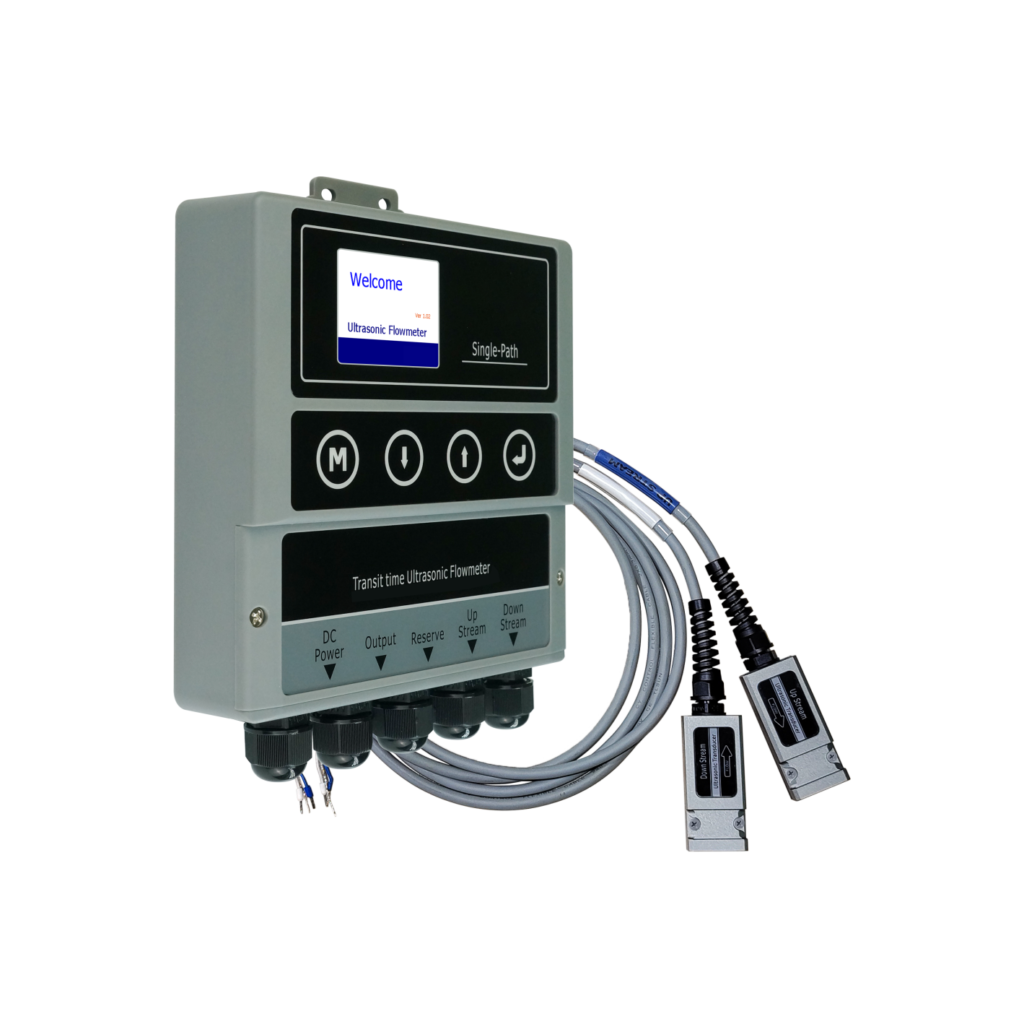
Clamp-on ultrasonic flow meters have become the go-to choice for measuring water and other clean liquids — and for good reason: they install on the outside of the pipe in minutes, without cutting the pipe, shutting down the process or losing pressure. But how can a device that never touches the liquid know how fast it is flowing? The answer is the transit-time principle.
The Transit-Time Principle: Sound as a Speedometer
Two ultrasonic transducers are mounted on the pipe, a short distance apart. Each transducer acts as both a speaker and a microphone: one sends an ultrasonic pulse to the other, travelling with the flow (downstream), then the pair swaps roles and a pulse travels against the flow (upstream).
- Sound travelling with the flow is carried by the liquid → arrives slightly faster.
- Sound travelling against the flow fights the current → arrives slightly slower.
The meter measures the difference between these two travel times (Δt) with nanosecond precision. Because sound is simply being carried by the moving liquid, that time difference is directly proportional to the flow velocity. Multiply velocity by the known pipe cross-section area and you get volumetric flow rate — typically displayed in m³/h, L/min or GPM.
Modern instruments repeat this ping-pong measurement hundreds of times per second and average the result, which is how a quality clamp-on meter reaches ±0.5% to ±1.0% of reading — comparable to many inline meters.
Why Measure From Outside the Pipe?
- No pipe cutting, no process shutdown — transducers simply strap or clamp onto the pipe wall, even on live, pressurised lines.
- Zero pressure loss and zero leak risk — nothing is inserted into the liquid, so nothing obstructs or corrodes.
- Huge pipe range from one instrument — the same meter covers DN25 to DN2000 or even DN5000; with compact models down to DN6.
- Chemical resistance for free — the transducers never contact aggressive liquids; even lined pipes can be measured.
- Portable spot-checks — battery-powered handheld versions let one technician survey dozens of measurement points per day.
If you are evaluating this technology for permanent installation, see our fixed clamp-on ultrasonic flow meter YF-C6 or the premium YF-C8 (±0.5%, up to DN5000); for surveys and temporary measurement, the portable YF-P1 is a good starting point.
What Liquids Can It Measure — and What Not?
The transit-time method needs the ultrasonic pulse to travel cleanly across the pipe, so it works best on clean, single-phase liquids: tap water, demineralised water, chilled and hot water, seawater, chemicals and solvents. A small amount of suspended solids or gas bubbles (a few percent) is tolerated by modern signal processing.
It is not suitable for heavily aerated or slurry-like liquids, where reflections scatter the signal — those applications call for Doppler-type instruments or other technologies. The pipe must also run full (not partially filled) for an accurate reading.
Typical Applications
Water supply networks and waterworks, HVAC chilled/condenser water balancing, pump and valve testing, chemical dosing lines, irrigation districts, building energy audits and process monitoring in factories. In short: anywhere you need reliable liquid flow data without touching the pipe.
Frequently Asked Questions
How accurate is a clamp-on ultrasonic flow meter?
Quality industrial units achieve ±1.0% of reading over a wide velocity range; premium models such as the YF-C8 reach ±0.5%. Accuracy depends on correct installation: a full pipe, adequate straight run and properly prepared pipe surface.
Do I need to cut the pipe or stop the process to install one?
No. That is the main advantage of clamp-on technology. Transducers are mounted on the cleaned outside surface of the pipe with coupling gel and straps or a mounting bracket — the process keeps running.
What pipe sizes are supported?
Depending on the model, from very small lines (OD 9 mm on compact meters) up to DN5000 (200") on the largest fixed units — one instrument family covers nearly all water and process pipes.
Related Reading
- What Is a Clamp-On Ultrasonic Flow Meter?
- Transit-Time vs Doppler Ultrasonic Meters
- How Accurate Is a Clamp-On Flow Meter?
- Factors That Affect Clamp-On Accuracy
- What Liquids Can an Ultrasonic Meter Measure?
Need Help Selecting a Flow Meter?
YS-Flux manufactures clamp-on ultrasonic flow meters for wholesale, export and OEM/private-label partners. Tell us your pipe size, liquid and application — our engineers will recommend the right model and quote within one business day. Request a Quote →
Browse our complete range on the Products page.