
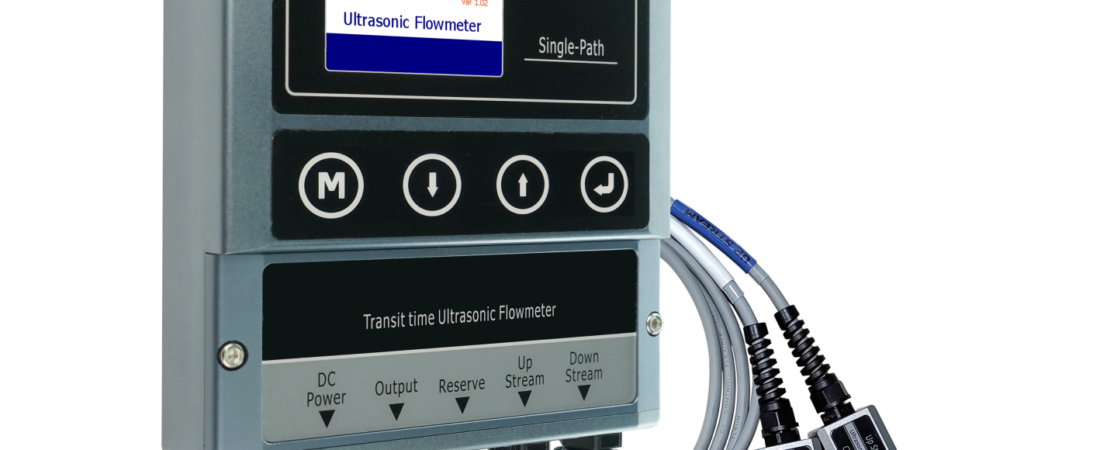
Clamp-on meters are non-intrusive instruments that measure from outside the pipe; for a general introduction start with our what is a clamp-on ultrasonic flow meter overview.
One of the most common questions before a first clamp-on purchase is: will it work on my pipe? The reassuring answer is that clamp-on ultrasonic meters measure through nearly every common pipe material — carbon steel, stainless steel, cast iron, copper, PVC, HDPE, and even lined pipes — because the ultrasound travels through the pipe wall rather than requiring contact with the liquid. What varies is not whether a material is “allowed”, but how easily sound passes through it and how carefully it must be set up. Here is a material-by-material guide.
Why Pipe Material Matters at All
The meter calculates flow from the velocity of sound through the liquid, but the ultrasonic pulse first has to travel through the pipe wall on the way in and out. Every material has a characteristic sound speed and acoustic impedance, which is why the instrument asks you to enter the pipe material, outer diameter and wall thickness during setup. Enter these correctly and the meter computes transducer spacing and signal timing for that exact wall. This is also why accurate pipe data is essential for accuracy — see our accuracy guide and the setup steps in the installation guide. The measurement principle itself is explained in how clamp-on meters work.
Materials That Work Best
- Carbon / mild steel — the most common industrial pipe and an excellent conductor of ultrasound. Clean, sound steel walls give strong, stable signals; standard transit-time meters perform very well.
- Stainless steel — acoustically similar to carbon steel; excellent results across sanitary, process and chemical lines.
- Copper — smooth, dense and uniform; very good signal transmission, common in HVAC and building services.
- PVC and other rigid plastics (uPVC, CPVC, ABS) — fully measurable. Plastic has a lower sound speed than metal, so entering the correct material (not assuming steel) is important; the meter recalculates accordingly. Very common in water treatment and chemical plants.
- HDPE / PE (polyethylene) — measurable, but the softer, thicker-walled and sometimes porous nature of HDPE attenuates ultrasound more. It usually still works with good surface contact, adequate wall-thickness data and occasionally Z-method mounting; signal strength should be checked carefully.
Materials That Need Special Care
- Cast iron and ductile iron — common in water mains. Sound works, but old cast iron can have a rough, scaled or graphitised inner surface and thick walls that scatter the signal. Heavy corrosion or tuberculation weakens readings; choose Z-method mounting, prepare the outer surface well, and premium high-power units (YF-C8) handle it best. Newer ductile iron with smooth liners is far easier.
- Lined pipes (cement-mortar, epoxy, rubber, PTFE, plastic-lined steel) — measurable, but the lining is a second acoustic layer. You must enter the lining material and thickness in addition to the steel wall. Soft rubber or thick cement liners attenuate the signal; bonded epoxy/PTFE liners are usually fine. Air gaps between liner and wall (a defect in old cement-lined pipe) can block the signal.
- Concrete and concrete-lined pipes — large transmission mains are often concrete or concrete-lined steel. These are measurable with the right technique (lower-frequency/long-range transducers, Z-method), but thick, porous or cracked concrete can make the signal marginal; a portable YF-P2 site survey is the recommended first step before committing to fixed instrumentation.
- Galvanised steel — works, though the zinc layer and any internal scaling should be accounted for; prepare the outer mounting area down to a smooth, dense surface.
- Composite / GRP / fibreglass (FRP) — generally measurable as it is non-metallic like plastic, but wall construction can be layered; provide accurate wall data and verify signal on site.
Pipe Conditions That Matter More Than Material
- Wall thickness and diameter accuracy — a few millimetres of error in wall thickness biases the result; measure rather than assume, especially on large and lined pipes.
- Inner wall condition — scale, rust, tuberculation and (most importantly) trapped air at a delaminated liner scatter or block ultrasound.
- Outer surface — loose paint, rust and insulation must be removed at the two transducer patches; dense intact paint can stay.
- Full pipe and clean liquid — transit-time needs a completely full pipe with clean, single-phase liquid; solids-laden or heavily aerated fluid is a method limitation rather than a material one (transit-time vs Doppler).
Quick Reference
| Pipe material | Clamp-on suitability | Notes |
|---|---|---|
| Carbon / mild steel | Excellent | Standard setup, strong signal |
| Stainless steel | Excellent | Sanitary/process lines |
| Copper | Excellent | HVAC, smooth uniform wall |
| PVC / CPVC / ABS | Very good | Enter plastic sound speed correctly |
| HDPE / PE | Good (verify signal) | Softer wall; check SQ, consider Z-method |
| Cast / ductile iron | Good with care | Old/scaled iron needs prep; premium unit helps |
| Lined (cement/epoxy/PTFE/rubber) | Good if liner data entered | Enter lining material + thickness |
| Concrete / concrete-lined | Possible (survey first) | Long-range transducers, Z-method, site test |
| GRP / fibreglass / composite | Usually measurable | Provide layered wall data, verify |
Model and Setup Pointers
- Small plastic/copper lines and tight spaces: compact YF-C3 family.
- General steel/PVC/copper plant and water networks: YF-C6 fixed clamp-on.
- Large iron mains, lined or challenging pipes, and difficult signals: YF-C8 premium with high-power transducers and Z-method.
- Unsure about an unusual material or lining? Survey with a YF-P1/YF-P2 portable first — the on-screen signal quality tells you immediately whether a fixed install will work. Model mapping by use case is in our application selection guide, and full material tables are in the manuals on the Downloads page.
In short: if the pipe is full of clean liquid and you can provide accurate material and wall data, a clamp-on ultrasonic meter will almost certainly measure it — the technology is material-agnostic far beyond where most buyers expect.
Frequently Asked Questions
Do clamp-on ultrasonic flow meters work on PVC and plastic pipes?
Yes. PVC, CPVC, ABS, HDPE and other plastic pipes are fully measurable. Because plastic has a lower sound speed than metal, it is important to select the correct pipe material in the meter setup and enter the actual outer diameter and wall thickness — the instrument then calculates transducer spacing and timing for that wall.
Can a clamp-on meter measure through lined or cast-iron pipes?
Yes, with care. For cement, epoxy, PTFE or rubber linings, enter both the steel wall and the lining material/thickness; bonded liners usually measure well, while soft rubber or delaminated cement liners can weaken the signal. Old cast iron with heavy scaling may need Z-method mounting, a prepared surface and a high-power premium unit (YF-C8).
What pipe material cannot be measured with a clamp-on meter?
There is no common rigid pipe material that is fundamentally excluded — steel, stainless, copper, PVC, HDPE, iron, lined and even concrete pipes can all be measured with the right technique. The real limitations are pipe conditions rather than material: a partially filled pipe, heavily aerated or solids-laden liquid, porous/cracked concrete, or an air gap behind a delaminated liner can defeat the signal. A portable survey unit confirms suitability on site in minutes.
Not Sure If Your Pipe Is Suitable?
YS-Flux clamp-on meters cover virtually all common pipe materials and diameters from OD 9 mm to DN5000. Send us your pipe material, outer diameter, wall thickness (and any lining), plus the liquid and temperature — our engineers will confirm compatibility, transducer choice and mounting method within one business day. Request a Quote →