
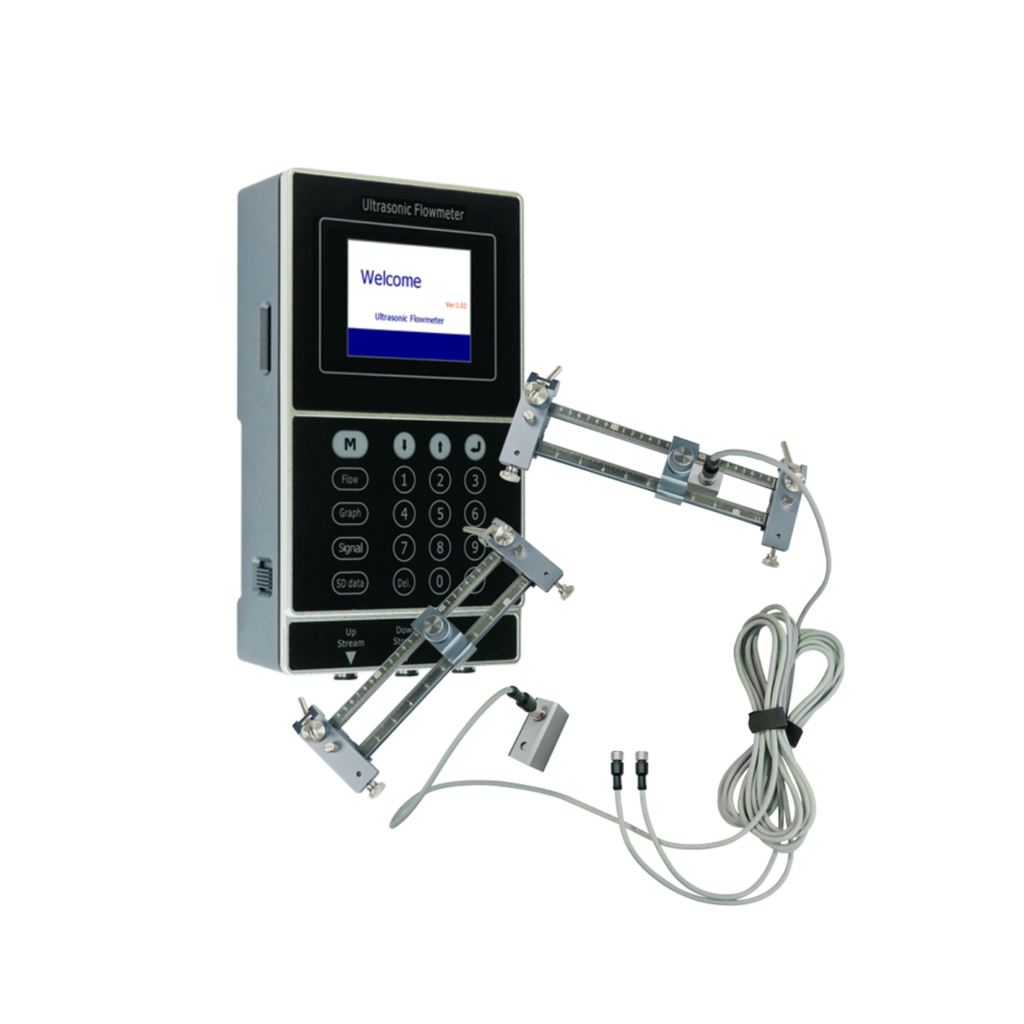
A fixed clamp-on meter lives on one pipe; a portable one belongs to whoever moves between pipes. Battery-powered, hand-carried and quick to mount, a portable ultrasonic meter turns flow measurement from a permanent installation into a service you can perform anywhere — on your own plant or, for contractors and distributors, on a customer’s site. If you are deciding between the two, our portable vs fixed comparison covers the trade-offs; here we focus on what people actually do with a portable unit. New to the technology? Start with the clamp-on flow meter overview.
1. HVAC Hydronic Balancing and Commissioning
In chilled-water and heating systems, design flow only materialises if every branch and terminal unit receives the right amount. Balancing engineers use a portable meter to measure actual flow at each riser, branch, AHU and chiller, adjust balancing valves, and re-measure until flows match design — then re-check seasonally. Because the meter clamps on externally with no shutdown, an occupied building keeps running while the system is balanced. Portable energy-logging (flow × ΔT) can also quantify chiller/boiler output.
2. Pump Performance Testing
Pumps wear, impellers get trimmed, and systems drift from their curve. A portable meter measures actual flow at a given head so maintenance teams can plot the operating point against the pump curve, confirm a pump is delivering rated flow, diagnose a blocked/fouled unit or an oversized pump wasting energy, and justify repair or replacement. It is the fastest way to verify pump health without installing a permanent meter.
3. Water Leakage and Night-Flow Surveys
Water utilities and large sites use portables for district metered area (DMA) studies and minimum night-flow analysis: clamp onto district mains during low-demand hours, log the minimum night flow, and compare it with legitimate night use — the excess indicates leakage. The same technique finds internal leaks on campuses, hospitals and industrial estates, and validates whether a reported leak has been repaired. The wide diameter coverage (up to DN5000 on the YF-P2) suits both building and transmission mains.
4. Verifying Installed Meters
Because a portable clamp-on reads to the same accuracy band as a permanent meter without touching the pipe (same transit-time core), it is routinely used to cross-check installed meters — magnetic, mechanical or existing ultrasonic units. Clip on adjacent to the suspect meter, log flow under the same conditions, and compare: a consistent offset flags calibration drift, fouling or a fault. This supports billing disputes, calibration audits and warranty claims.
5. Commissioning and Temporary Flow Checks
During plant start-up, retrofit or process change, engineers need short-term flow data to prove a loop works, set a valve, or confirm capacity before permanent instrumentation is fitted. A portable gives immediate readout and onboard logging for minutes or days, then moves to the next point — ideal where buying a fixed meter for every temporary measurement is uneconomic.
6. Site Surveys Before Buying Fixed Meters
A smart procurement step: before committing to permanent clamp-on or inline meters across a site, bring a portable to confirm each proposed point actually works — pipe material, lining, signal quality and flow conditions. The on-screen signal reading reveals difficult spots (and the fixes; see our troubleshooting guide) so the fixed meters are specified with confidence, not guesswork.
7. Rental, Service and Contract Measurement
Service companies, water-treatment contractors and ESCOs use portables as a billable service tool: flow verification, energy audits, pollution/influent checks, and ad-hoc diagnostics for clients who do not own a meter. One instrument serves many customers and pays for itself quickly.
Why Portable Works for These Jobs
- No shutdown, no cutting — measure on live, pressurised pipes in running plants and occupied buildings.
- One unit, almost any pipe — interchangeable transducers cover small-bore to large mains across steel, copper, PVC, HDPE and lined pipes.
- Battery and onboard logging — capture rate and total to SD/USB over a survey, with no wiring (fixed wiring and PLC/SCADA integration is the job of fixed meters — see outputs and integration).
- Minutes per point — enter pipe data, apply couplant, clamp on, check signal, read flow.
Typical Users
| User | Main portable uses |
|---|---|
| HVAC / commissioning engineers | Hydronic balancing, chiller/boiler output, flow proving |
| Maintenance / plant teams | Pump testing, troubleshooting, temporary checks |
| Water utilities | DMA / night-flow leakage surveys, meter verification |
| Service contractors / ESCOs | Client flow/energy audits, contract measurement, rental |
| Facility managers / estates | Internal leak detection, sub-metering checks, retrofit surveys |
| Distributors / OEMs | Pre-sale site confirmation, customer support and demos |
Choosing between portable and fixed, and mapping models to applications, is covered in the application selection guide; manuals and transducer tables are on the Downloads page. For permanent, continuous monitoring the YF-C6/YF-C8 and energy meter YF-E6 are the fixed counterparts.
Frequently Asked Questions
What is a portable ultrasonic flow meter used for?
Typical uses include HVAC hydronic balancing and commissioning, pump performance testing, water leakage/night-flow (DMA) surveys, verifying installed meters against drift, temporary flow checks during commissioning or retrofit, site surveys before buying fixed meters, and contract/rental measurement by service companies. It clips onto a live pipe, logs flow to SD/USB, and comes straight off — one instrument serves many points.
Can a portable meter replace fixed meters?
Not for continuous monitoring. A portable is ideal for periodic, many-point or temporary measurement and surveys; a fixed meter stays on one point, is permanently powered and wired to PLC/BMS/SCADA for 24/7 monitoring, billing and alarms. Many organisations own both — fixed meters at key points, plus a portable for audits, balancing, leakage walks and verifying the fixed units.
How accurate is a portable clamp-on meter for surveys and verification?
On the same pipe, correctly installed, a portable reaches the same transit-time accuracy band (±0.5–1.0%) as a fixed meter, which is exactly why it is used to verify installed meters and for pump/balancing work. Accuracy depends on installation — accurate pipe data, good coupling, adequate straight run and a stable signal — rather than portability.
Add a Portable Meter to Your Toolkit
The YF-P1 covers general portable survey work, while the YF-P2 adds the 3.5″ rotating IPS touchscreen and range up to DN5000 for large mains. Both ship with transducer sets, couplant, straps and a carry case. Tell us your typical pipe sizes and applications — our engineers will recommend the configuration within one business day. Request a Quote →
Browse our complete range on the Products page.
Questions about your application? Contact our team or request a quote — we respond within 24 hours.