
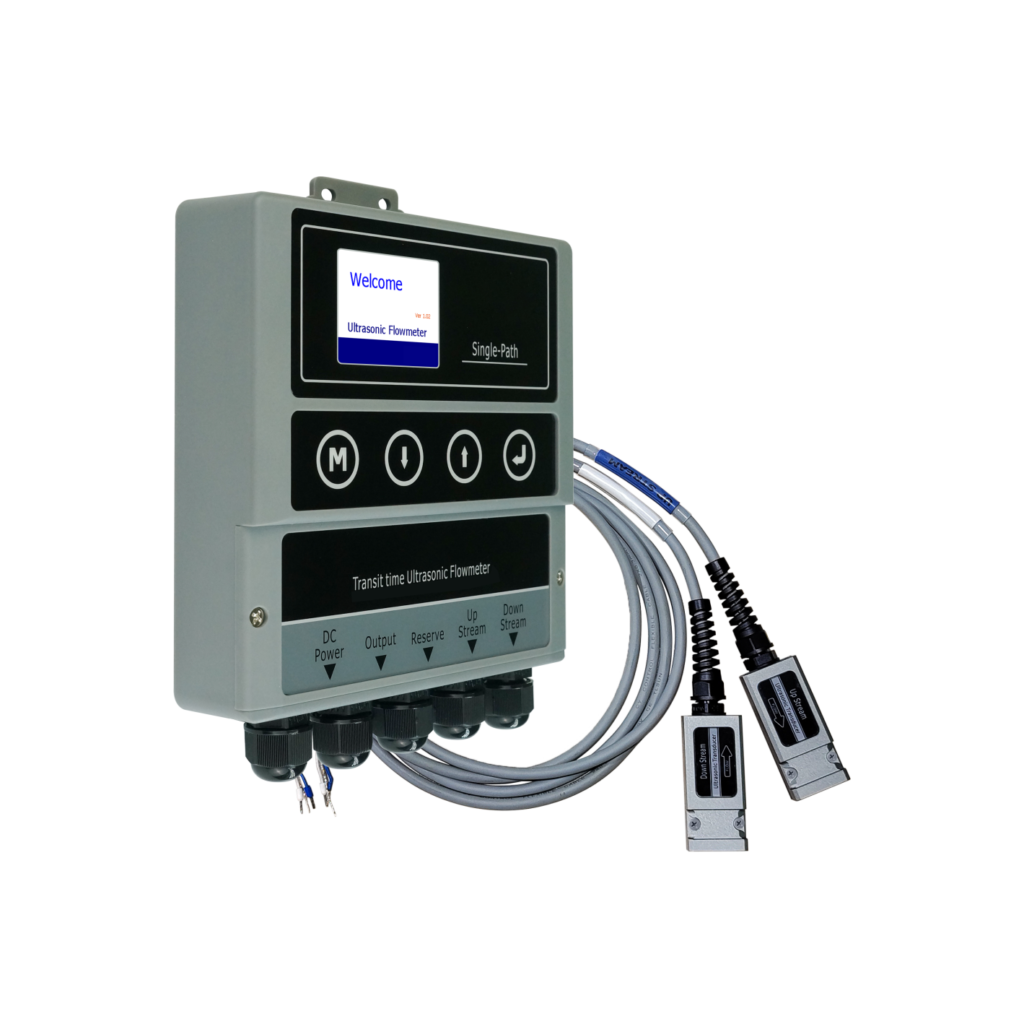
Yes — and this is one of the biggest reasons buyers switch to clamp-on technology. A clamp-on ultrasonic flow meter is installed entirely on the outside of the pipe. The transducers strap onto the pipe wall while the line remains live, full and pressurised. There is no cutting, no welding, no hot tapping, no drain-down, no depressurisation and — most importantly — no process shutdown. This article explains how that is possible, how it compares to inline installation, and the conditions for a successful live fitting.
Why No Shutdown Is Needed
Traditional inline meters (magnetic, turbine, vortex, positive displacement) are wetted instruments: they have to sit inside the flow path, which means the pipe must be cut and the meter flanged or welded in — requiring isolation, draining, civil works and downtime. A clamp-on meter never penetrates the pipe. It measures flow by sending ultrasonic pulses through the pipe wall from the outside, so the liquid, pressure and process are completely undisturbed. The measurement principle is explained in our transit-time overview and the technology in our clamp-on flow meter introduction.
What Live Installation Actually Involves
- Select the mounting point — a straight, accessible run of pipe, full of liquid, away from pumps/valves/elbows (typically ≥10D upstream straight run). The pipe stays in service throughout.
- Prepare the surface — clean and lightly abrade the two transducer spots to remove loose paint, rust and scale, then wipe clean.
- Enter pipe parameters — pipe material, outer diameter and wall thickness; the meter calculates the exact transducer spacing.
- Apply couplant and mount — spread acoustic coupling gel, press the transducers onto the prepared patches, and secure with stainless straps, chains or a bolted clamping frame. Nothing pierces the pipe.
- Check the signal and start measuring — verify signal quality (stable SQ ≥ 50) and read flow immediately. A typical single point takes 30 minutes to 2 hours. Portable users can be measuring within minutes.
Full mounting rules and the V-method/Z-method choices are in our clamp-on installation guide.
Clamp-On vs Inline: The Shutdown Difference
| Factor | Inline (wetted) meter | Clamp-on ultrasonic |
|---|---|---|
| Pipe work | Cut pipe, fit flanges/weld | None — strap on outside |
| Shutdown required? | Yes — isolate and drain | No — live, pressurised line |
| Hot work / permits | Often welding / hot work | None |
| Install time | Hours to days + civil works | ~30 min–2 h per point |
| Pressure loss / leak risk | Small pressure drop, new joints | Zero |
| Removal / relocation | Permanent, another shutdown | Minutes, trace-free |
See the full clamp-on vs inline comparison.
Where Live Installation Matters Most
- Continuous processes — water treatment plants, power stations, chemical plants and data centres that cannot stop for maintenance windows.
- Retrofit and occupied buildings — adding metering to existing HVAC, district energy or factory pipework where a shutdown would disrupt operations or tenants.
- Large-diameter mains — cutting a DN500–DN2000 transmission main for an inline body is enormously expensive; a clamp-on premium unit fits without touching it.
- Temporary measurement and surveys — balancing loops, pump tests, meter verification, commissioning: a portable YF-P1/YF-P2 clips on and comes straight back off.
- Hazardous or aggressive fluids — because nothing contacts the liquid, there is no leak path and no chemical-compatibility concern with wetted parts.
Conditions for a Successful Live Fitting
- The pipe must be completely full of liquid during installation and measurement.
- Access to bare, sound pipe surface — if the line is lagged, remove insulation at the two transducer patches (lagging can be replaced afterwards).
- Pipe surface must be reachable and dry enough to mount; very hot lines (above ~80 °C standard) need high-temperature transducers.
- Normal line pressure is fine — clamp-on works on pressurised systems because nothing penetrates the wall; just ensure a safe working position around the pipe.
- Clean, single-phase liquid for transit-time; heavy solids/aeration need Doppler types. Accuracy under live conditions is covered in our accuracy explainer, and model matching in our selection guide.
Which Model for Live Installations?
- Permanent live-line metering, DN25–DN2000: YF-C6 fixed clamp-on.
- Large mains, high accuracy (±0.5%) or high temperature: YF-C8 premium.
- Small pipes / tight spaces: compact YF-C3 and related compact models.
- Temporary surveys and retrofit verification: YF-P1 / YF-P2 portable.
Datasheets and mounting dimensions are available on our Downloads page.
Frequently Asked Questions
Do I need to stop the flow or depressurise the pipe to install a clamp-on meter?
No. Clamp-on ultrasonic transducers are mounted on the outside of the pipe while it remains live, full and at normal operating pressure. There is no cutting, hot tapping, draining or shutdown — surface preparation and strap/bracket mounting are all external work.
Is any hot work or special permit required?
Generally no welding or hot work is involved, because nothing penetrates the pipe. Standard site access and working-at-height or insulation-removal procedures apply as usual; the instrument itself adds no leak or pressure risk.
How long does a live installation take?
A typical permanent clamp-on point takes roughly 30 minutes to 2 hours, including locating a suitable straight run, preparing the surface, mounting the transducers and verifying signal quality. Portable survey units can be measuring within minutes of arrival.
Planning a Live-Line Installation?
YS-Flux clamp-on ultrasonic meters are designed for installation on running, pressurised pipes — fixed, compact and portable models for surveys and retrofit projects. Send us your pipe size, material, pressure, temperature and liquid, and our engineers will confirm the right model and mounting configuration within one business day. Request a Quote →
Browse our complete range on the Products page.